
You set the last glass on the table, step back, and it looks lovely. Then you realize the main dish is still in the kitchen—and there is nowhere for it to land.
Small tables make this happen all the time. A table that seats two to four has just enough room for place settings, so every decorative piece competes directly with the food.
The best small dining table decor works with the space left after your plates, glasses, and serving dishes are in place.
Before you add anything, try one quick test: set out the plates, the glasses, and the biggest dish you plan to serve from. Whatever space remains is your real decorating budget.
Choose decor for that space—not for the empty table you imagined.
These seven small dining table decor ideas are designed around that leftover room. Each one keeps the table beautiful, functional, and comfortable enough for guests to see and talk to one another.
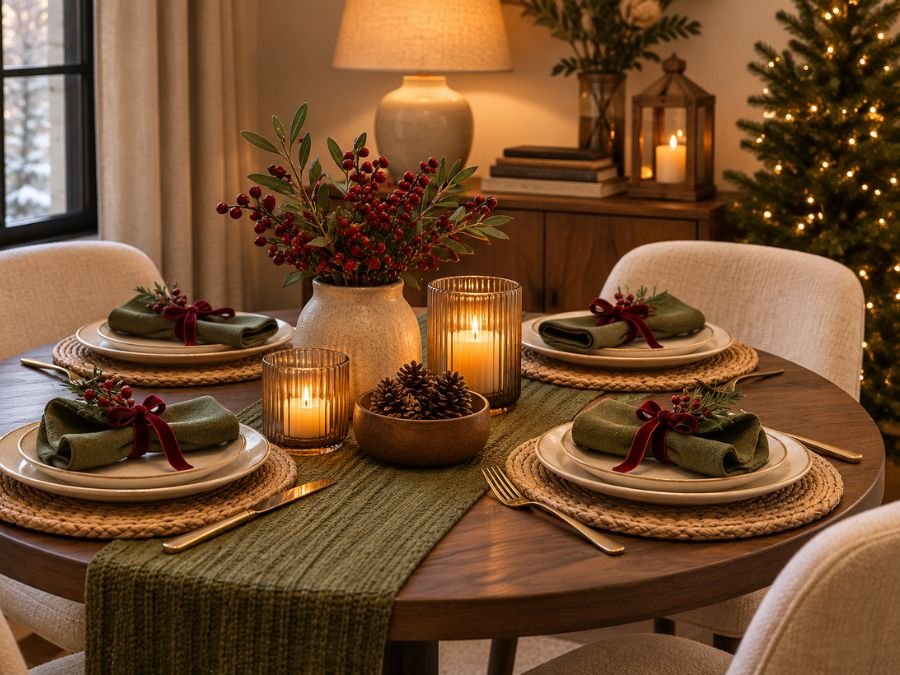
1. Add Color Above the Plate
A napkin is one of the easiest ways to bring color to a small dining table setting because it takes up almost no extra table surface.
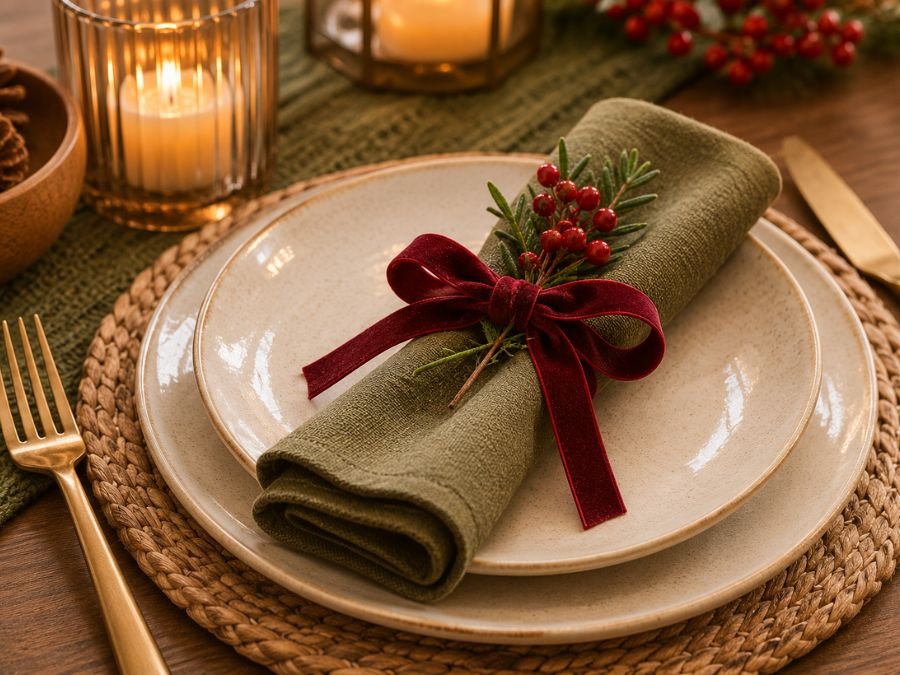
Fold a cloth napkin in half, then into thirds, so it forms a long, slim rectangle. Lay it across the center of the plate and tie a thin cotton ribbon around the middle in a simple knot.
Leave the two ribbon ends about three inches long so they fall evenly without spreading too far across the plate.
For a calm, fresh combination, try a pale blue napkin over a white ceramic plate. Soft green, muted beige, dusty rose, or warm brown can work just as well depending on the rest of your dining room.
You do not necessarily need to buy anything new. A ribbon, cotton twill tape, or even a simple folded napkin can provide enough detail.
Quick check: Hold the finished napkin against your plate. If the knot crowds the rim or makes the setting feel busy, loosen it slightly or skip the ribbon and use the fold alone.
As an Amazon Associate I earn from qualifying purchases.
Burgundy Velvet Ribbon on Amazon
2. Gather the Centerpiece on an Easy-Lift Tray
Instead of scattering several decorative pieces across the table, group them on one small tray.
A short vase holding a single olive branch paired with a small bowl of olives or dates is enough to make the center feel styled.
Keep everything low so guests can easily see one another across the table.
A tray also gives your small dining table centerpiece a clear boundary. Instead of decor slowly spreading across the tabletop, everything stays contained in one small footprint.
Before buying a tray, test the size with something you already own.
Put a dinner plate, cutting board, or serving board in the middle of the table. Arrange the vase and bowl on top, then place your largest serving dish nearby.
If everything fits comfortably, you have found roughly the right tray size.
The best part comes when dinner arrives: lift the entire tray away in one move and place it on a nearby counter, shelf, or console. Your main dish can immediately take its place.
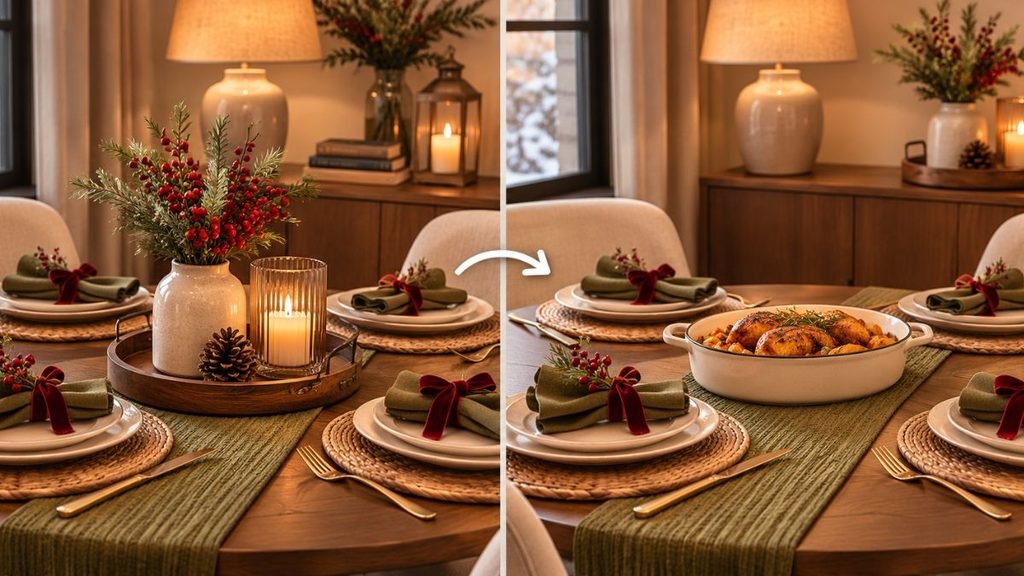
Small Decorative Serving Tray on Amazon
3. Decorate for a Round or Narrow Dining Table
The shape of the table should influence how you decorate it.
Round Tables
On a small round dining table, everyone sits fairly close to the center. That makes a low centerpiece the easiest option.
Keep the middle open enough for one shared serving dish that all four guests can reach.
If the table is especially compact, place the serving dish slightly off-center between two guests and let one small decorative element sit on the opposite side.
Narrow Rectangular Tables
A narrow rectangular table has a different problem: the center is usually a thin strip.
Instead of a full centerpiece, use one slim decorative element near one end, such as a single olive branch in a narrow vase.
Keep the central area open for food.
You can place a serving dish near the middle of the long side where guests on either side can reach it, while leaving the opposite end available for bread or salad.
A simple rule: Sit in each chair and reach toward the center. If you have to stretch around a vase to reach the food, move the vase.
This small test is often more useful than measuring the table.
4. Let the Tablecloth Supply the Pattern
When your tablecloth provides the visual interest, you need fewer decorative objects.
A light stripe, small check, subtle floral, or soft block print under plain white or cream dishes can make the entire table feel finished.
For many compact tables, a full tablecloth works better than individual placemats.
It creates one calm surface and can hide scratches, worn edges, or a tabletop finish you do not love.
Four placemats can be harder to manage on a very small table because their edges may overlap or push too far toward the serving area.
Choose placemats only when your tabletop is wide enough for each one to sit separately without crowding the center.
Before you commit: Set your dishes on the fabric and look at the table from a seated position. If the pattern is so busy that the edge of the plate disappears into it, choose a quieter print or a solid color.
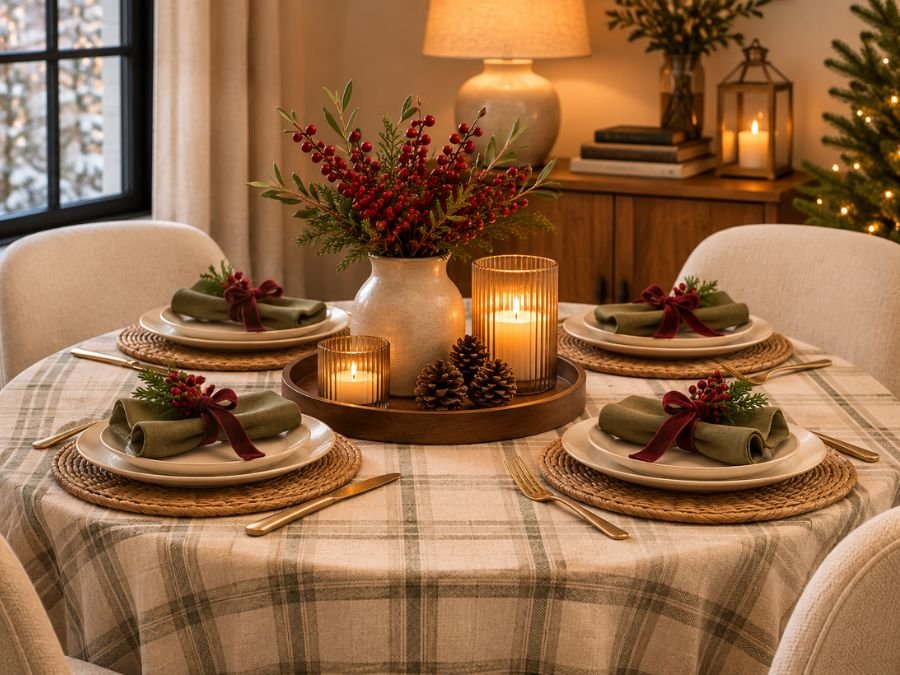
Neutral Patterned Tablecloth on Amazon
If you are also trying to make the rest of a compact home feel less crowded, you may like our guide to small space organization ideas.
5. Use Your Serving Dish as the Decor
A beautiful serving dish can do two jobs at once.
Picture a green salad inside a soft blue ceramic bowl. The bowl already adds enough color to the middle of the table, so you may not need a traditional centerpiece at all.
This is especially useful on a small table because the most important object in the center is also functional.
To make the arrangement feel intentional, repeat the serving bowl’s color once somewhere else.
For example:
- A blue ribbon around each napkin
- A blue stripe in the tablecloth
- Soft blue drinking glasses
- A small blue detail in the dishes
One repeated accent is usually enough.
Repeating the same color in too many places can make the table feel overly coordinated rather than relaxed.
Try this first: If you own more than one serving bowl, place each one on the table empty. Choose the one whose color, texture, or shape already works with something else you own.
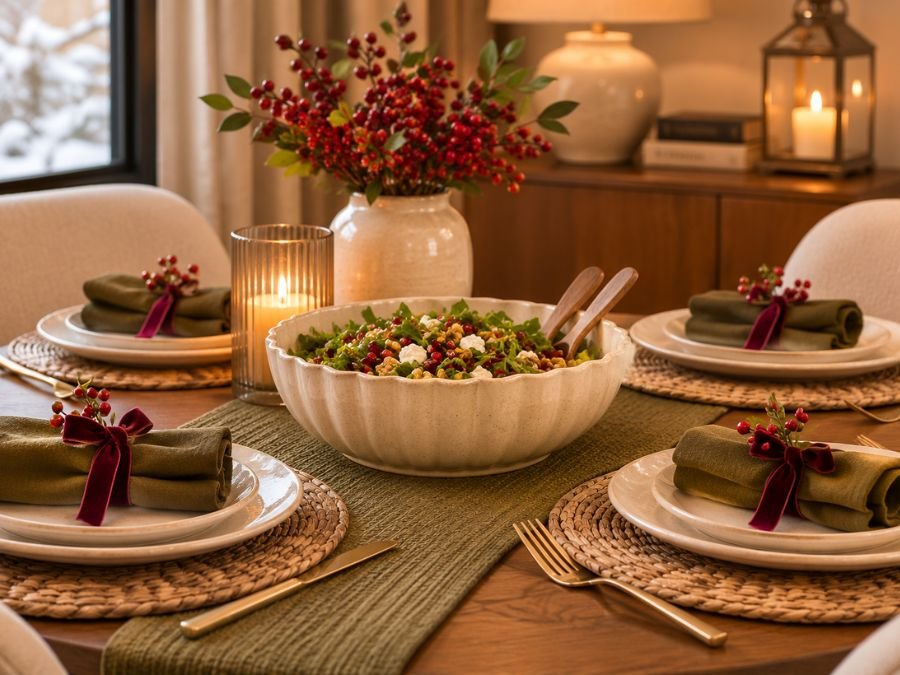
Shop a Cream Ceramic Serving Bowl on Amazon
6. Move the Lighting to the Side
Lighting can change the mood of the dining area without taking away any tabletop space.
Instead of placing a candle or small lamp in the center of a compact dining table, bring the light from the edge of the room.
A small lamp on a sideboard, console, kitchen counter, or nearby shelf can create a soft glow while keeping the entire tabletop available for dinner.
This can also feel warmer than relying only on a bright overhead light.
Sit in each chair and check the lighting from your guests’ perspective.
You should be able to see the food and everyone’s faces clearly without looking directly into a bare bulb or bright lampshade.
If the light feels too strong, lower the brightness or move the lamp slightly farther to one side.
Lighting test: Turn off the main overhead light and switch on the side lamp. If the table is still comfortable to eat at, you have added atmosphere without sacrificing a single inch of tabletop.
Shop a Small Warm Table Lamp on Amazon
7. Create a Side Station for Everything You Do Not Need All the Time
Not everything has to sit on the dining table.
Imagine you are hosting four people around a compact round table.
Keep only the things everyone will use throughout the meal within reach:
- The main serving dish
- Glasses
- Perhaps a small bread basket
Move everything else to a nearby surface.
A water pitcher for refills, dessert plates, extra napkins, sauces, or additional serving dishes can stay on the kitchen counter, a sideboard, or even a small stool beside the table.
Bring them over only when you need them.
This prevents the table from becoming crowded halfway through dinner and makes it easier for everyone to eat comfortably.
You do not need a dedicated dining room console. A clear stretch of kitchen counter works just as well.
Set it up early: Before guests arrive, place the pitcher, extra napkins, and dessert dishes in your chosen side spot so you are not looking for them later.
If you enjoy practical ideas for keeping small spaces functional, you can also browse our small space organization guide.
A Small Dinner Table Set for Four
Here is one simple setup you can recreate using pieces you may already own.
Imagine a round dining table about 36 inches across.
The Setup
Place four dinner plates around the table at roughly the four points of a compass, leaving about an inch between each plate and the edge of the table.
A standard dinner plate is usually around 10 inches wide. Arranged this way on a 36-inch round table, the plates can leave roughly a 14-inch open area in the center, depending on their exact placement.
Place each drinking glass just above and slightly to the right of its plate so the space between each guest and the center remains clear.
Fold each napkin into a slim rectangle and place it across its plate. Tie it with a ribbon if you want a little extra color.
Then place one useful serving dish in the center.
A blue ceramic bowl filled with green salad can become the centerpiece itself. Repeat the blue once in the napkin ribbon or another subtle detail.
Then stop decorating.
Leave the remaining space open.
Keep the bread basket, water pitcher, extra plates, and anything else on a nearby kitchen counter or shelf until you need them.
Before guests arrive, sit in each chair.
Can you reach the serving bowl comfortably?
Can you see the person sitting across from you?
Can a guest lift a glass without bumping into something decorative?
If the answer is yes, the table is ready.
Cozy Holiday Table Essentials
You do not need many pieces to make a small holiday table feel warm and inviting. A few simple details can create the look without taking over the dining space:
- Shop Burgundy Velvet Ribbon on Amazon
- Shop a Small Decorative Serving Tray on Amazon
- Shop a Neutral Plaid Tablecloth on Amazon
- Shop a Cream Ceramic Serving Bowl on Amazon
- Shop a Small Warm Table Lamp on Amazon
The goal is not to fill the table. It is to create a cozy seasonal setting while leaving enough room for dinner, conversation, and the people gathered around it.