
If you’re trying to figure out how to organize a small closet with lots of clothes, you’ve probably already tried the obvious fixes. You folded everything, removed a few pieces, added a basket or two—and within a week, the closet started feeling crowded again.
The problem is not always that you own too many clothes. Often, a small closet simply has too much unused space in the wrong places: empty space below short shirts, a top shelf filled with loose items, shoes covering the floor, or a closet door that is doing nothing.
The goal is not to squeeze as much as possible into the closet. The goal is to give every category a permanent home so clothes are easy to see, easy to reach, and easy to put away.
This guide walks you through a complete reset and 12 practical solutions. You do not need to use every organizer listed here. Choose the ones that solve the actual problems in your closet.
For more ideas for organizing tight spaces throughout the home, see our Small Space Organization Ideas guide.
Start With a Real Closet Reset
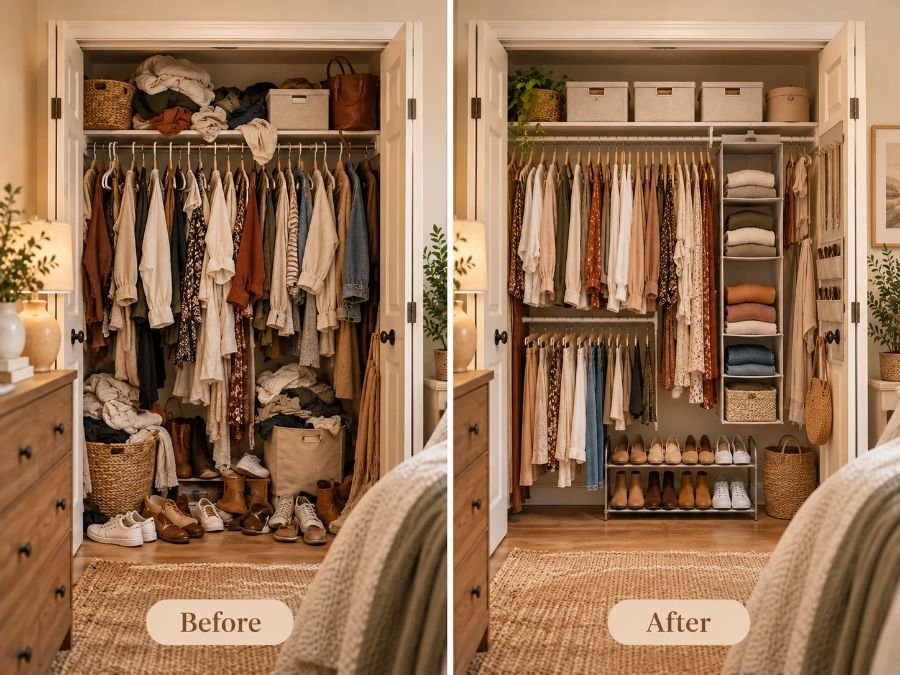
Before buying a single organizer, empty and measure your closet.
Buying storage products before knowing what your closet actually needs often creates more clutter instead of solving it.
1. Remove Everything
Take all clothes, shoes, bags, boxes, and accessories out of the closet.
An empty closet makes it much easier to see which areas are currently being wasted.
2. Sort Everything Into Categories
Create separate groups for:
- Hanging clothes
- Folded clothes
- Shoes
- Handbags
- Accessories
- Seasonal clothing
- Rarely used items
Do not worry about putting everything back yet.
3. Measure the Empty Closet
Measure:
- Interior width
- Closet depth
- Rod height
- Shelf depth
- Space above the top shelf
- Space between hanging clothes and the floor
- Door clearance
- Empty wall or corner space
Also measure the approximate length of your hanging clothes.
This is especially important if you plan to add a second hanging rod, shoe rack, drawer unit, or hanging shelves.
4. Find the Wasted Space
Look for areas such as:
- Empty space below shirts
- Unused space above the top shelf
- The back of the closet door
- Empty corners
- Floor space under short clothing
- Wide shelves with messy piles
These are the areas your organizers should fix.
5. Decide What Needs Easy Access
Everyday clothing should be the easiest to reach.
Seasonal clothes, formalwear, extra bedding, and rarely used bags can go higher up or outside the closet.
Think of the closet as a group of zones:
Hanging + Folded Clothes + Shoes + Bags + Accessories + Seasonal Storage
When every category has one home, maintaining the closet becomes much easier.
1. Replace Bulky Hangers With Slim Velvet Hangers
The problem
Thick plastic and wooden hangers can take up valuable rod space, especially in a very small closet.
The solution
Replace everyday hangers with slim velvet hangers.
Their narrow shape allows clothing to sit closer together, while the flocked surface can help slippery tops stay on the hanger.
Where to use them
Use them across the main hanging rod for lighter everyday clothing.
What to hang on them
They work well for:
- Blouses
- T-shirts
- Tank tops
- Lightweight dresses
- Shirts
- Lightweight pants
Heavier jackets and coats may need sturdier hangers.
Sweaters are usually better folded rather than hung if hanging causes the shoulders to stretch.
How to organize the rod
Try not to mix many different hanger styles.
Once you switch hangers, group clothes by category:
- Tops
- Shirts
- Pants
- Dresses
- Jackets
You can then organize each category by sleeve length or color.
Before buying
Count how many hanging pieces you actually own and check that the hanger hooks fit your closet rod.
Disclosure: This post contains affiliate links. I may earn a commission at no extra cost to you.
Recommended product: Amazon Basics Slim Velvet Hangers
2. Add a Second Hanging Rod
The problem
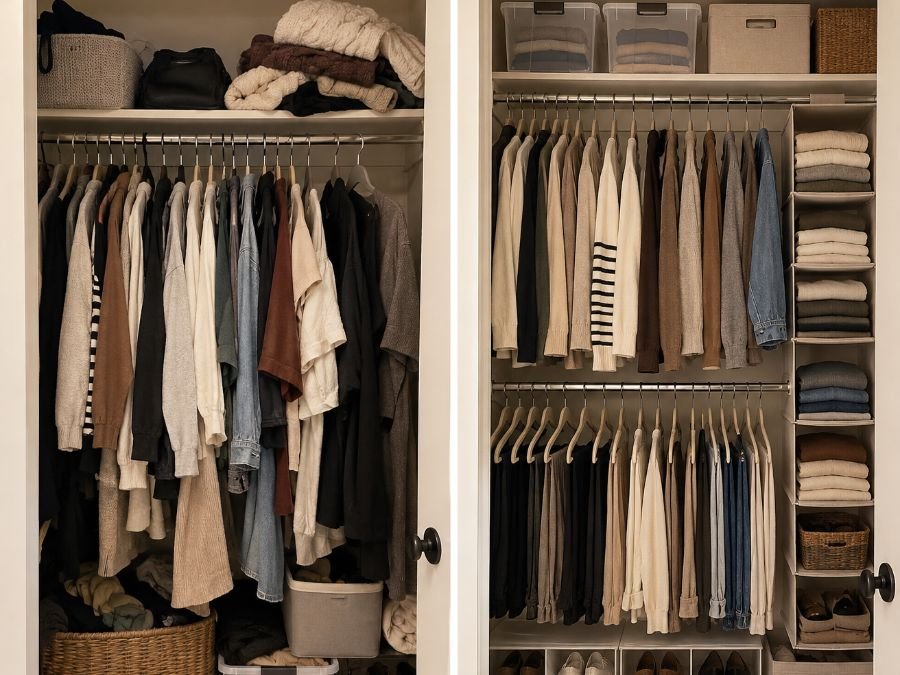
If most of your clothes are shirts, skirts, or folded pants, there may be a large amount of unused space underneath them.
The solution
Install an adjustable double hanging rod below part of your existing rod.
This can turn one section of hanging space into two separate levels.
Where to put it
Use the second rod only underneath shorter clothing.
Do not place it underneath dresses, long coats, or other full-length garments.
How to arrange it
A simple layout could be:
Upper rod:
Shirts, blouses, jackets, and frequently worn tops.
Lower rod:
Skirts, folded pants, shorts, or additional short tops.
Keep another section of the original rod open for longer clothes.
Measure before buying
Do not rely on a standard closet height.
Instead:
- Measure from your existing rod to the floor.
- Measure the length of the clothes you plan to hang on the upper rod.
- Measure the clothing you want on the lower rod.
- Make sure both rows can hang without touching each other or the floor.
Also check the organizer’s weight limit and make sure your existing closet rod is secure enough to support the additional clothes.
Recommended product: Simple Houseware Adjustable Closet Rod
3. Turn the Top Shelf Into Seasonal Storage
The problem
The top shelf often becomes a dumping ground for random items.
Because it is harder to reach, it should not hold things you need every morning.
The solution
Use the top shelf for lightweight, less frequently used items.
Good examples include:
- Seasonal clothing
- Lightweight extra bedding
- Rarely used handbags
- Travel accessories
- Special-occasion clothing
Avoid storing very heavy containers overhead.
What organizers to use
Choose either:
- Fabric storage bins
- Clear storage bins with lids
Clear vs. fabric bins
Clear bins are helpful when you want to see what is inside without opening every container.
Fabric bins work well for soft clothing and can make an exposed shelf look more visually organized.
How to arrange them
Keep one category in each bin.
For example:
- Winter sweaters
- Summer clothes
- Extra linens
- Travel items
- Occasion bags
Label the front so you do not have to pull everything down to remember what is inside.
Measure before buying
Measure:
- Shelf depth
- Shelf width
- Available height above the shelf
Choose containers that can slide out easily without scraping the walls or ceiling.
Recommended product: Clear stackable storage bins
4. Add Hanging Shelves When You Have No Built-In Shelving
The problem
Some small closets have only a rod.
That gives you plenty of hanging space but almost nowhere to store folded clothing.
The solution
Add a hanging closet shelf organizer.
It attaches to the closet rod and creates several vertical cubbies without requiring built-in shelves.
This can be particularly useful for renters.
What to store inside
Use it for:
- T-shirts
- Jeans
- Workout clothes
- Lightweight sweaters
- Small bags
- Scarves
- Folded basics
How to use it
Place lighter clothing in the upper and middle compartments.
Heavier folded items can go lower, but do not overload the organizer.
If shelves begin to sag, reduce the amount stored inside.
Where to place it
Put it at one end of the rod so it does not divide your hanging clothes unnecessarily.
Measure before buying
Measure:
- Available rod-to-floor height
- Organizer width
- Space needed for nearby hanging clothes
If you also plan to put shoe storage underneath, make sure both organizers can fit without colliding.
Recommended product: Hanging closet shelf organizer
5. Use Shelf Dividers to Stop Clothing Piles From Falling Over
The problem
Wide shelves can look useful, but piles of jeans and sweaters often lean into each other.
Then you pull out one shirt and the entire stack collapses.
The solution
Use shelf dividers to create smaller sections.
Where to use them
Shelf dividers work well on a wide top or middle shelf.
What to store between them
They are useful for:
- Sweaters
- Jeans
- Hoodies
- Towels
- Structured handbags
Instead of creating one long row of folded clothes, divide the shelf into several manageable stacks.
How to arrange them
Create sections approximately wide enough for one comfortable stack rather than trying to fit as many piles as possible.
Keep the stacks low enough that you can remove an item without knocking everything over.
Before buying
Measure the thickness and depth of your shelf.
Shelf dividers attach differently, so make sure the design fits your particular shelf.
Recommended product: Acrylic or wire shelf dividers
6. Turn the Closet Floor Into Proper Shoe Storage
The problem
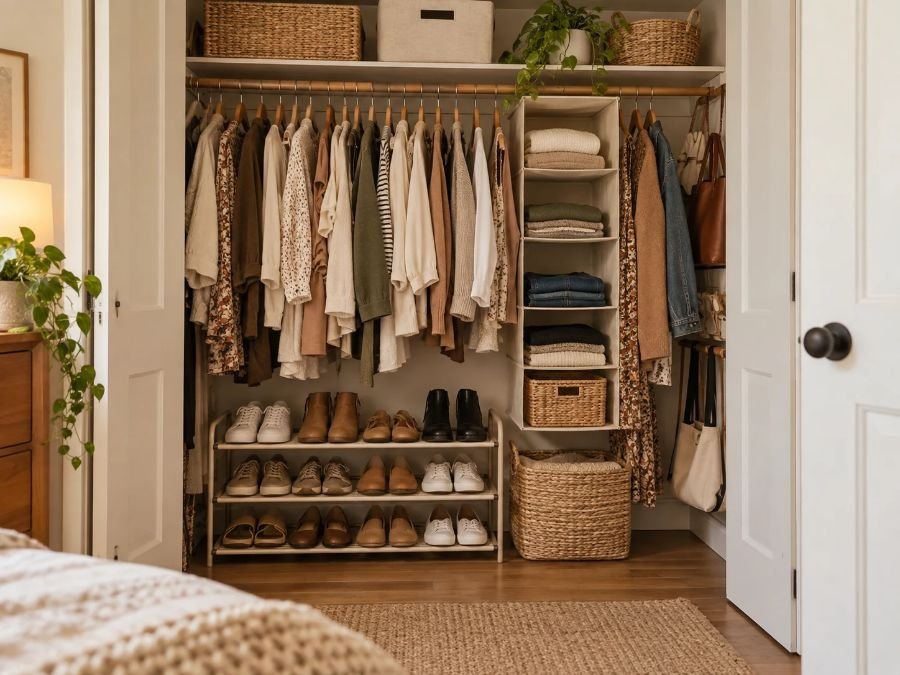
Shoes spread across the floor can make even an otherwise organized closet look messy.
They also waste the vertical space above them.
The solution
Choose your shoe organizer based on the amount of available floor space.
Option 1: Stackable Shoe Rack
Best for everyday shoes such as:
- Sneakers
- Flats
- Sandals
Stacking shelves lets you use vertical space instead of creating one long line of shoes.
Option 2: Expandable Shoe Shelf
A good option if you need the rack to fit an unusual closet width.
Option 3: Clear Shoe Boxes
Useful for shoes you wear less frequently, such as dress shoes or special-occasion pairs.
They can protect the shoes while allowing you to see what is inside.
How to arrange shoes
Put the shoes you wear most often in the easiest-to-reach position.
Less frequently used shoes can go higher or toward the back.
Tall boots need enough vertical clearance and should not be forced underneath hanging clothes.
Measure before buying
Measure:
- Closet floor width
- Floor depth
- Height underneath hanging clothes
- Length of your largest shoes
Make sure the shoe organizer does not stick out far enough to stop the closet door from closing.
Recommended product: Expandable shoe rack
7. Use the Closet Door
The problem
The inside of a closet door is often unused even when the closet itself is completely full.
The solution
Add an over-the-door organizer.
What can go there
Depending on the design, use it for:
- Scarves
- Belts
- Small handbags
- Hats
- Pajamas
- Flats
- Small accessories
How to organize it
Keep frequently used items at a comfortable height.
Avoid loading the organizer with bulky or extremely heavy items.
Door clearance matters
Before buying, close the door and look at the space between the door and your hanging clothes or shelves.
The organizer plus its contents must fit within that space.
Also check that the hooks fit the thickness of your door.
If your closet door has very little clearance, choose a thin organizer rather than a deep pocket system.
Recommended product: Over-the-door closet organizer
For more ways to make use of overlooked spaces around the home, see our Small Space Organization Ideas guide.
8. Add a Narrow Drawer Unit if You Have Floor Space
The problem
Not every small bedroom has enough room for a large dresser.
If the closet has unused floor space, you may be able to move some folded clothing into the closet itself.
The solution
Add a narrow drawer unit.
Where to put it
Place it:
- At the end of the closet
- Under short hanging clothes
- Beside a hanging section
What to store inside
Use drawers for small folded categories such as:
- Underwear
- Socks
- Sleepwear
- Workout clothes
- T-shirts
- Everyday basics
Assign one category to each drawer.
Before buying
Measure the width, depth, and height of the available space.
Then check how far the drawers extend when fully open.
A drawer unit that technically fits inside the closet is not useful if you cannot open the drawers.
Recommended product: Narrow closet drawer unit
9. Store Handbags Vertically Instead of Stacking Them
The problem
Handbags often end up piled on top of each other.
That makes the bottom bags difficult to reach and can cause soft bags to lose their shape.
The solution
Store bags upright using either:
- Shelf dividers
- A purse organizer
- A hanging bag organizer
How to arrange them
Keep frequently used bags at eye level.
Less-used or special-occasion bags can go higher.
Structured bags can stand upright between shelf dividers.
Soft bags can be lightly filled with tissue paper or clean soft fabric to help them hold their shape.
Before buying
Measure your largest handbag and compare its height and width with the organizer compartments.
Recommended product: Hanging purse organizer
10. Move Seasonal Clothing Out of Prime Closet Space
The problem
If summer and winter clothes stay in the same small closet all year, half your easiest-to-reach space may be occupied by clothing you are not currently wearing.
The solution
Move off-season clothes away from your main daily-access area.
Storage options
Use:
- Top-shelf bins
- Under-bed storage containers
- Storage bags
- Vacuum storage bags when appropriate
How to organize seasonal storage
Before storing clothes:
- Wash and completely dry them.
- Sort by season.
- Label the container.
- Store the container somewhere dry and appropriate for the items.
Rotate clothing when the season changes.
Be careful with vacuum storage
Do not automatically vacuum-seal every type of clothing.
Some garments rely on loft, padding, delicate fibers, or structure that can be affected by long-term compression.
Always check the garment’s care instructions before compressing it.
When in doubt, use a regular breathable or rigid storage container instead.
Recommended product: Under-bed storage bags
11. Give Small Accessories Their Own Storage
The problem
Small items are easy to lose because they do not have enough visual presence to stay organized on a shelf.
Belts, scarves, jewelry, and hats can quickly become tangled or buried.
The solution
Use small organizers specifically designed for accessories.
Useful options
- Multi-slot accessory hanger
- Belt hanger
- Scarf hanger
- Drawer dividers
- Small hooks
- Jewelry organizer
Where to use them
Depending on your closet, accessories can go:
- On the rod
- On the door
- Inside a drawer
- On an empty wall
How to organize them
Keep each accessory category together.
For example:
- Belts on one hanger
- Scarves on another
- Jewelry in divided compartments
- Hats on hooks
This makes it much easier to find an item without searching through the entire closet.
Recommended product: Multi-tier scarf hanger
12. Create a System That Keeps the Closet Organized
A small closet can look perfect on organization day and become messy again within a week.
The final solution is not another storage product.
It is a simple maintenance system.
Organize Clothing by Category
Keep similar items together:
- Tops
- Pants
- Dresses
- Jackets
- Workout clothes
Once categories are established, you can sort them further by color if that helps you find things faster.
Keep Everyday Items Easy to Reach
Your most frequently worn pieces should not require:
- A step stool
- Moving several bins
- Digging through a deep pile
- Removing other clothes first
Reserve difficult-to-reach areas for rarely used items.
Try a One-In, One-Out Rule
When you bring a new clothing item into an already full closet, consider removing something you no longer wear.
This prevents the closet from slowly exceeding the system you built.
Do a 10-Minute Weekly Reset
Once a week:
- Put stray clothing back
- Rehang items
- Refold messy stacks
- Return shoes to their rack
- Check the floor
- Return accessories to their organizer
Ten minutes regularly is much easier than reorganizing the entire closet every few months.
Choose the Right Organizer for Your Closet
| Problem | Best Solution | Where to Put It |
|---|---|---|
| Not enough hanging space | Double hanging rod | Below short hanging clothes |
| Bulky hangers taking up room | Slim velvet hangers | Main closet rod |
| No built-in shelves | Hanging shelf organizer | Hanging from closet rod |
| Shoes covering the floor | Stackable shoe rack | Closet floor |
| Folded piles falling over | Shelf dividers | Closet shelf |
| Bags piled together | Purse organizer or shelf dividers | Upper or middle shelf |
| Wasted door space | Over-the-door organizer | Closet door |
| Seasonal clothes taking over | Storage bins | Top shelf or under bed |
| Folded basics have no home | Narrow drawer unit | Closet floor |
| Accessories are getting lost | Accessory hanger or hooks | Door, rod, wall, or drawer |
Example: How to Organize a Small 4-Foot-Wide Closet
Imagine a small closet with one hanging rod and one top shelf.
Instead of trying to store everything in the same way, divide the closet into zones.
Left Side: Long Clothing
Keep dresses, long jackets, and any other full-length pieces on one side.
Do not install a second rod underneath this section.
Right Side: Double Hanging Space
Use the upper rod for shirts and jackets.
Install an adjustable second rod below them for skirts, folded pants, or additional short items.
Closet Floor: Shoes
Place one or two stackable shoe shelves underneath the shortest hanging clothes.
Keep everyday shoes in the easiest positions to reach.
Top Shelf: Seasonal Storage
Use labeled lightweight bins for:
- Seasonal clothes
- Extra bedding
- Occasion bags
Hanging Shelf Organizer
If you still need folded storage, hang a shelf organizer at one end of the rod for:
- T-shirts
- Jeans
- Workout clothing
- Lightweight sweaters
Door: Accessories
Use a slim over-the-door organizer for:
- Belts
- Scarves
- Small bags
- Other lightweight accessories
The result is not simply more storage.
Each category now has its own zone.
What Not to Do in a Small Closet
Do Not Buy Organizers Before Measuring
An organizer is only useful if it fits your actual closet.
Measure first. Shop second.
Do Not Fill Every Inch
An organizer packed completely full becomes difficult to use.
Leave enough room to remove and replace items easily.
Do Not Put Bulky Bins in Your Best Storage Areas
Large storage containers should not occupy the easiest-to-reach space if they contain things you rarely use.
Move seasonal bins higher up or elsewhere.
Do Not Build Very Tall Clothing Stacks
Tall stacks fall over and make lower pieces difficult to reach.
Create smaller sections using shelf dividers.
Do Not Mix Seasonal Clothing With Everyday Clothing
Keep today’s wardrobe where you can see it.
Move off-season pieces away from the prime-access zone.
Do Not Buy a Shoe Rack Without Checking Hanging Clearance
Measure the distance between the closet floor and the bottom of your hanging clothes.
The rack should fit underneath without pushing into your clothes.
Do Not Overload Hanging Organizers
Check the weight rating and distribute items sensibly.
If a hanging organizer begins sagging, remove some of the weight.
A One-Afternoon Small Closet Organization Plan
Want to tackle the whole project in one day?
Follow this order.
Step 1: Empty and Sort
Remove everything and separate it into categories.
Set aside anything you already know you no longer wear.
Step 2: Measure
Measure the closet while it is completely empty.
Record the dimensions before shopping.
Step 3: Create Zones
Decide where each category will live:
- Hanging
- Folded
- Shoes
- Bags
- Accessories
- Seasonal clothing
Step 4: Fix Hanging Space
Replace bulky hangers if necessary.
Then install a second hanging rod if your clothing lengths and closet dimensions allow it.
Step 5: Add Folded Storage
Install hanging shelves, shelf dividers, bins, or a small drawer unit depending on what your closet lacks.
Step 6: Organize Shoes and Accessories
Set up your shoe storage and give belts, scarves, bags, and small accessories permanent homes.
Step 7: Put Everything Back by Frequency of Use
Frequently worn clothing goes in the easiest-to-reach areas.
Rarely used and seasonal pieces go higher up or outside the closet.
Frequently Asked Questions
How do you organize a small closet with too many clothes?
Start by removing everything and sorting it by category. Measure the empty closet, identify unused vertical space, and create separate zones for hanging clothes, folded items, shoes, bags, accessories, and seasonal clothing.
Slim hangers, a double hanging rod, hanging shelves, and seasonal storage can help use the available space more efficiently.
How can I double hanging space in a small closet?
If you mostly hang shorter clothing, add an adjustable second hanging rod below your existing rod.
Measure the length of both rows of clothing first to make sure there is enough clearance.
Keep a separate full-length section for dresses and long coats.
How do I organize a closet without shelves?
A hanging shelf organizer can create folded storage directly from the closet rod.
You can also use a narrow drawer unit on the floor, an over-the-door organizer, and stackable shoe storage.
What should go on the top shelf of a closet?
Use the top shelf for lightweight items you do not need every day, such as seasonal clothing, lightweight extra linens, occasion bags, and travel accessories.
Store them in labeled bins so they are easy to identify.
How do you store shoes in a very small closet?
Use the empty floor area underneath short hanging clothes.
A stackable shoe rack or expandable shelf works well for everyday pairs, while clear shoe boxes can work for less frequently worn shoes.
Are hanging shelf organizers worth it?
They can be very useful when a closet has a rod but little or no shelving.
They work best for lightweight folded clothes and accessories.
Always check the organizer’s dimensions and weight capacity before filling it.
How do I keep a small closet organized long term?
Give each category a permanent location, keep frequently worn items easiest to reach, and do a quick weekly reset.
When the closet starts getting too full, remove items instead of continuously adding more storage products.